From PCB Supply Chain Resilience to Supply Chain Intelligence: A New Approach to PCB Sourcing in 2026
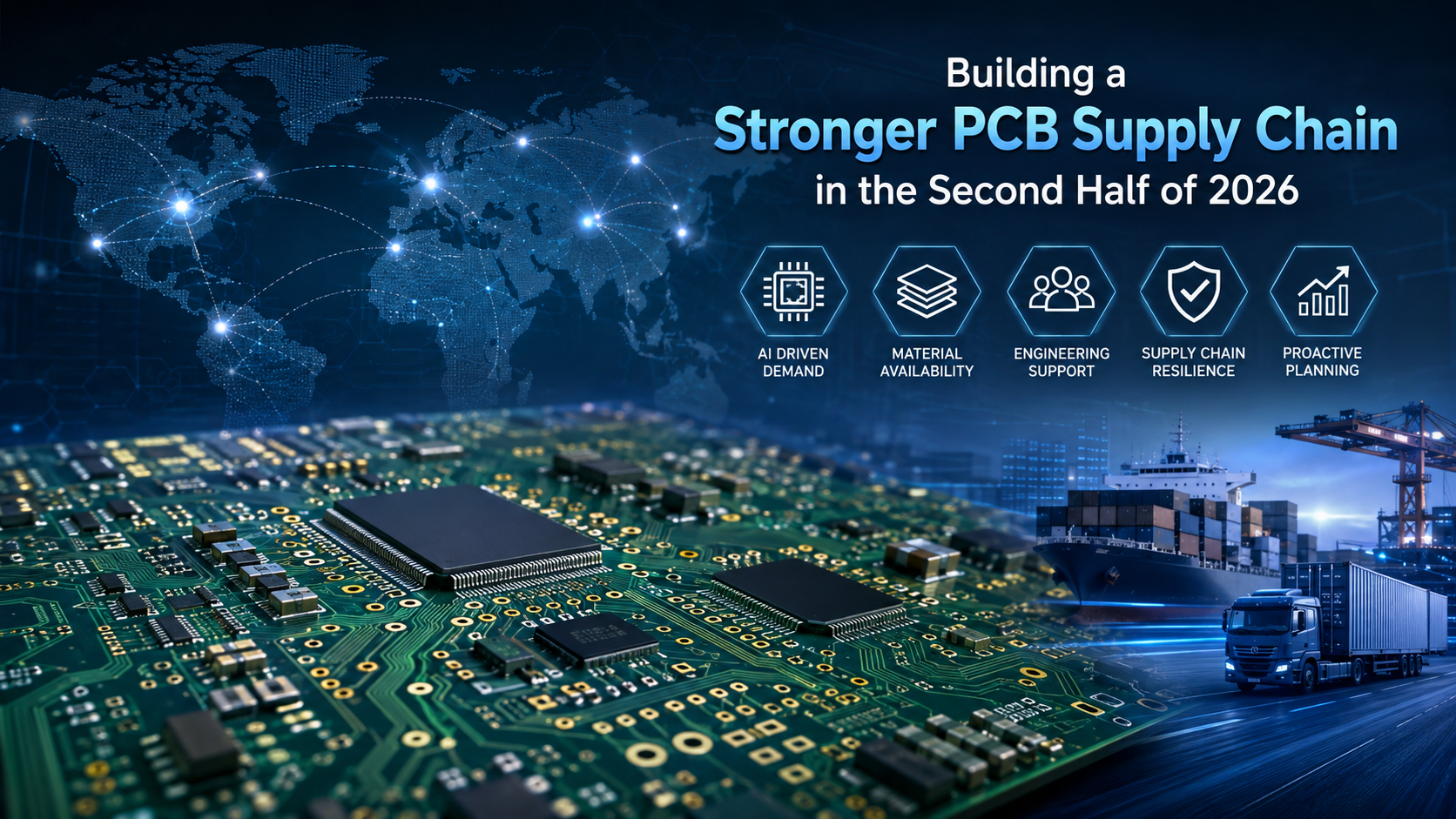
The PCB industry entered 2026 with a clear set of challenges: rising material costs, tighter capacity, longer lead times, geopolitical uncertainty, and increasing demand for advanced electronic products.
Over the past several months, much of the industry discussion has focused on supply chain resilience — how manufacturers and EMS companies can reduce risks and maintain stable production.
But as the second half of 2026 progresses, another question is becoming increasingly important:
Is resilience enough, or do companies need to manage their PCB supply chains more proactively?
AI Demand Is Changing the PCB Supply Chain
The rapid expansion of AI infrastructure is reshaping the electronics supply chain.
AI servers, data centers, high-speed networking equipment and advanced computing platforms require increasingly sophisticated PCBs, including higher layer counts, HDI structures, controlled impedance and advanced low-loss materials.
At the same time, the demand for high-performance laminates is putting pressure on upstream material capacity. Recent industry reports indicate that shortages are no longer limited to advanced materials and are beginning to affect standard FR-4 and thicker copper-clad laminates as well.
This creates a new challenge for PCB buyers:
A supplier may have enough manufacturing capacity, but can it secure the right materials at the right time?
That distinction is becoming increasingly important.
Price Is No Longer the Only Procurement Metric
For many years, PCB sourcing decisions were primarily based on:
Unit price
Lead time
Quality
Payment terms
These factors remain important, but they are no longer sufficient.
When material availability becomes uncertain, the lowest quotation does not necessarily represent the lowest total cost.
A delayed PCB shipment can lead to:
Production interruptions
Assembly line downtime
Expedited logistics costs
Delayed product launches
Additional inventory requirements
As a result, PCB procurement is gradually moving from price-driven purchasing toward risk-adjusted purchasing.
The real question is no longer simply:
“Who can offer the lowest PCB price?”
It is increasingly:
“Who can provide the most reliable supply at a predictable total cost?”
Second Sources Are Becoming More Important
One of the simplest ways to reduce PCB supply risk is to avoid depending on a single supplier.
For EMS manufacturers and OEMs, maintaining a qualified second PCB source can provide valuable flexibility when:
Demand suddenly increases
Existing suppliers reach capacity
Material availability changes
A new project requires different technology
Delivery schedules become compressed
A second source does not necessarily mean replacing an existing supplier.
Instead, it can serve as additional capacity, backup capacity, or a qualified alternative when the primary supply chain faces unexpected pressure.
This approach is particularly valuable for products with long lifecycles or critical delivery requirements.
Engineering Capability Is Becoming Part of Supply Chain Security
Another important change is the growing connection between engineering capability and procurement security.
A PCB supplier is no longer simply expected to manufacture according to Gerber files.
For increasingly complex boards, engineering teams may need to evaluate:
Stack-up design
Impedance requirements
Material selection
HDI structures
Hole and via technology
Copper thickness
Thermal requirements
Manufacturability
Early engineering communication can identify potential manufacturing risks before production begins.
This can reduce redesigns, delays and unexpected cost increases — making engineering support an important part of supply chain resilience.
Better Planning Can Reduce Supply Chain Pressure
In a volatile market, waiting until production is about to start before purchasing PCBs can create unnecessary risk.
Companies can improve supply stability by:
1. Forecasting PCB demand earlier
Share realistic demand forecasts with suppliers whenever possible.
2. Identifying critical materials
Determine which PCB materials or specifications may have longer procurement cycles.
3. Qualifying alternative suppliers in advance
Do not wait until a supply problem occurs to begin supplier qualification.
4. Reviewing new projects early
Engineering and procurement teams should communicate before mass production begins.
5. Maintaining flexible production capacity
A supplier with flexible capacity can become an important buffer when demand changes unexpectedly.
These measures transform PCB procurement from a reactive process into a more proactive supply strategy.
The PCB Supplier of the Future
The PCB supplier of the future will not be judged by price alone.
Customers will increasingly look for partners that can provide:
Stable materials + reliable capacity + engineering support + consistent quality + flexible production + transparent communication
This is especially important as PCB technology continues to evolve alongside AI, data centers, automotive electronics, industrial automation, medical electronics and other high-performance applications.
The PCB industry is not simply experiencing a temporary shortage.
It is going through a structural transformation in demand, technology and supply chains.
Companies that recognize this shift early will be better positioned to control costs, reduce supply risks and respond faster to new opportunities.
Looking Ahead
As we move into the second half of 2026, PCB sourcing is becoming less about finding the cheapest supplier and more about building the right supply network.
A resilient supply chain is a good starting point.
But a proactive, flexible and well-qualified supply chain will be what helps manufacturers remain competitive in an increasingly complex electronics industry.
The future of PCB sourcing is not simply about buying boards. It is about managing risk, capacity, technology and long-term supply together.
Leave your message