Is Your Supplier Really Doing OK?
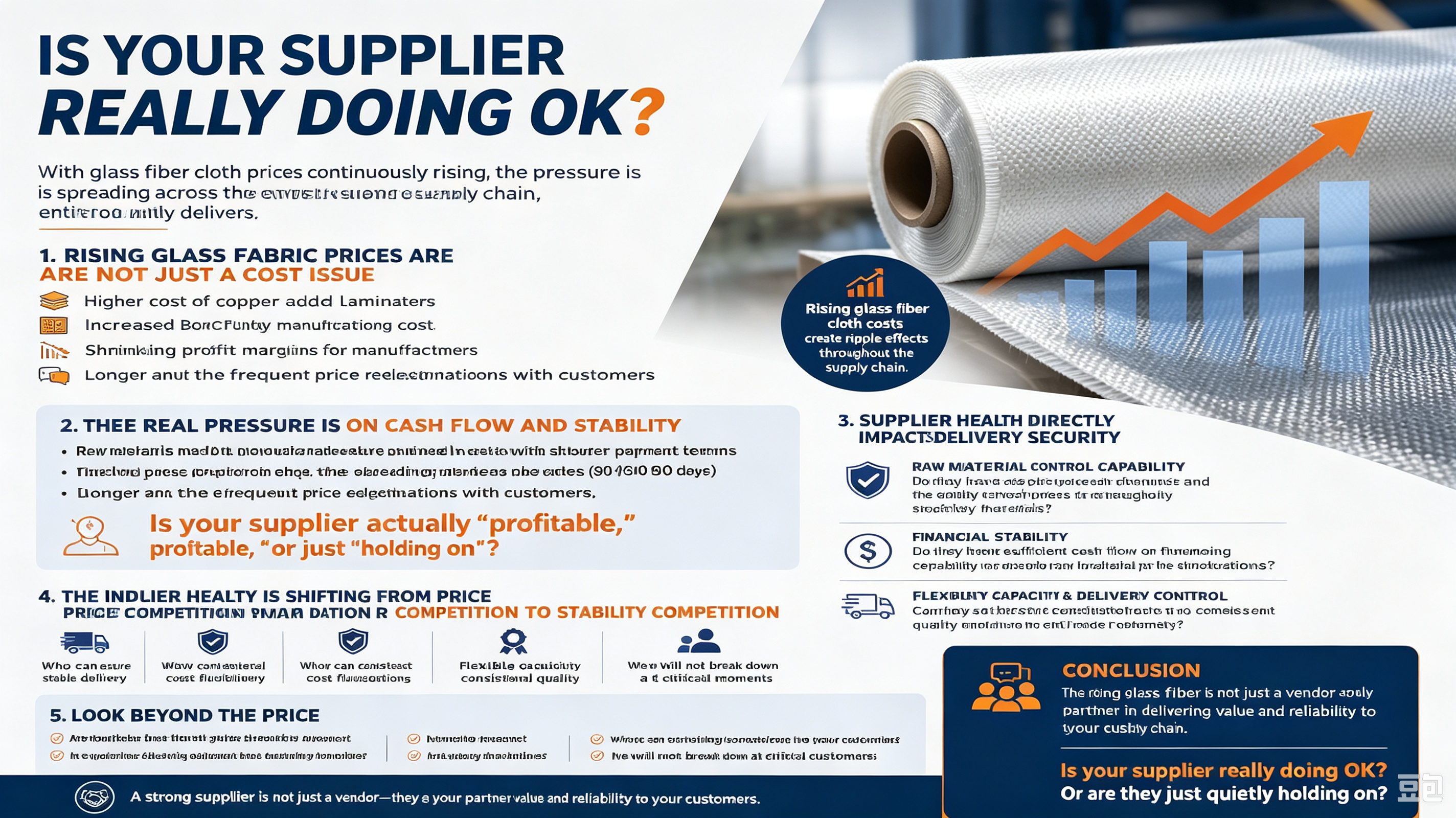
PCB Industry Analysis: Rising Glass Fiber Cloth Prices and Supply Chain Stability
The PCB industry is currently facing a new challenge that deserves attention: the continuous increase in glass fiber cloth (fiberglass fabric) prices.
For companies involved in PCB manufacturing, electronics production, and composite material sourcing, this trend has become increasingly noticeable.
At first glance, it may appear to be a simple material price fluctuation. However, the impact goes far beyond cost increases. It is gradually affecting supply chain stability, delivery reliability, production planning, and the long-term sustainability of suppliers.
1. Rising Glass Fiber Cloth Prices Are More Than a Cost Issue
Glass fiber cloth is one of the key base materials used in copper clad laminates (CCL) and multilayer PCB manufacturing.
Any significant price movement in this material directly affects the entire downstream industry, including:
• Higher copper clad laminate costs;
• Increased PCB manufacturing expenses;
• Reduced profit margins for manufacturers;
• More frequent price negotiations between suppliers and customers.
Many people may assume that the solution is simple: increase product prices and transfer the additional cost to customers.
However, in reality, this is not always possible.
In highly competitive markets, price increases cannot always be fully passed on, especially for long-term contracts, annual pricing agreements, and projects with fixed budgets.
As a result, many suppliers must absorb part of the increased costs themselves.
2. The Real Pressure Is on Cash Flow and Business Stability
When glass fiber cloth prices continue to rise, the first major pressure is often not on end customers, but on manufacturers and suppliers operating in the middle of the supply chain.
Typical challenges include:
• Raw materials requiring immediate payment or shorter payment terms;
• Finished products sold with longer payment cycles (30/60/90 days);
• Inventory value fluctuations caused by material price changes;
• Increased working capital requirements as order volume grows.
On the surface, receiving more orders may appear positive.
However, behind the orders, cash flow pressure can become increasingly serious.
This leads to an important question:
Is your supplier truly growing healthily, or are they simply trying to maintain operations under increasing pressure?
3. Supplier Health Directly Impacts Delivery Security
During stable market conditions, many companies focus mainly on price competitiveness.
However, during periods of industry volatility, supplier resilience becomes equally important.
A reliable PCB supplier should have strong capabilities in the following areas:
Raw Material Management Capability
Ability to maintain stable material sourcing and manage cost fluctuations.
Financial Stability
Ability to maintain healthy operations during challenging market conditions.
Flexible Production Capacity and Delivery Control
Ability to respond quickly to customer demand while maintaining delivery reliability.
4. The PCB Industry Is Shifting from Price Competition to Stability Competition
The increase in glass fiber cloth prices is not simply a temporary cost issue.
It represents a deeper change within the PCB supply chain.
The industry is gradually moving from a price-driven competition model toward a stability-driven competition model.
In the future, the key questions will not only be:
Who can provide the lowest price?
More importantly:
• Who can guarantee stable delivery?
• Who can withstand cost fluctuations?
• Who can maintain consistent product quality?
• Who can continue supporting customers during challenging periods?
5. Look Beyond Price When Selecting a PCB Supplier
When evaluating suppliers, customers may need to look beyond quotations and consider deeper questions:
• Are delivery schedules being affected by material cost pressure?
• Are quotation adjustments becoming more frequent?
• Is the supplier changing inventory strategies due to uncertainty?
• Are they becoming more selective about accepting new projects?
Price remains an important factor, but long-term cooperation requires a more comprehensive evaluation of supplier capability and stability.
Conclusion
The rising cost of glass fiber cloth is only the visible part of a larger supply chain challenge.
Behind this trend is a deeper restructuring of cost pressure, operational risks, and supplier resilience across the PCB industry.
For electronics manufacturers and EMS companies, choosing the right PCB partner is becoming more important than ever.
A stable supplier is not only able to provide competitive pricing — but also the manufacturing reliability, technical support, and long-term cooperation needed to help customers succeed.
Is your supplier truly doing well, or are they quietly holding on under pressure?
Leave your message